06 September 2013

Susan Haley’s Novel about Émile Petitot


We’ve been busy in the shop this week printing, sewing and binding Susan Haley’s new novel, Petitot, in advance of her September reading tour in the west and in the north.

In the novel, Susan Haley explores the troubled life and dubious claims of Father Émile Petitot, a controversial nineteenth-century missionary Oblate priest, linguist and ‘explorer’ whose fifteen years beneath the Arctic Circle were punctuated by scandal, delusional behaviour and episodes of outright madness and paranoia These problems caused him to be shuffled from mission to mission, temporarily excommunicated and even forcibly hospitalized by the bishop. Petitot’s story is framed by the contemporary story of Marcus, a young man who, fresh out of college and reeling from the failure of a marriage that had barely even begun, takes a teaching job in a tiny northern-Canadian native community. While struggling to grasp his own predicament, he finds himself entangled in much larger community tragedies – the suicide of an aging priest and the death of two young students from exposure. But it is his discovery of the writings of Émile Petitot which finally threatens to unhinge Marcus, launching him on an obsessive quest for answers.

Susan of course lived up north in Fort Norman for a number of years, where she ran a charter airline with her partner. In what I believe is the most northerly-sweeping Gaspereau Press tour ever, Susan will read in Edmonton, Yellowknife, Calgary and Saskatoon though mid-September. (At the Calgary and Saskatoon events she will be reading with Sean Johnston, who also has a novel out with Gaspereau this fall.) You can find up-to-the-moment details on our website.

As well as maps drawn by Jack McMaster, Petitot includes reproductions of some of Émile Petitot’s own sketches. This one is on the jacket.


Below is a short video clip of Connie sewing signatures for Susan’s book on the sometimes cantankerous Smyth sewing machine in our bindery. A signature is what we call a press sheet after we have folded it three times, resulting in a 16 page section of the book. A book comprised of a bunch of signatures which were made by folding a press sheet three times is called an octavo or 8vo book (octo for the eight pages printed on each side of the press sheet). The term signature originates from the marks printers often put at the foot of the top page of each section of the book to indicate which order the sections were to be gathered in. Signature one is pages 1 to 16, signature two is pages 17 to 32, etc.
One side of an imposed 8vo press sheet for Don McKay’s Muskwa Assemblage.

In the video, Connie is placing signatures (which have already been gathered in order) onto a conveyer. They travel to the anvil where they are flipped up and sewn together into a book block. After the book blocks are crushed in a clamp for a while to compress the threads into the spine, they are ready for binding.


ANDREW STEEVES ¶ PRINTER & PUBLISHER

04 September 2013

Divino Jure Typographus


A mysterious envelope with a Detroit return address on it appeared on my desk today. Opening it, I discovered a moving poster from my friend and sometimes co-conspirator Amos Paul Kennedy, Jr. The poster was printed on a run-of-th-mill map of Amos’s longtime state of residence, Alabama, highlighting the importance of voting in general and the suppression of the Black vote in particular.

Coincidentally, Nova Scotians presently await a provincial election call, expected early this fall. There is much speculation about whether the incumbent New Democratic government will be returned by the people. But there is also much concern about declining voter turnout, especially among younger voters. Vote! Vote!


Also expected this fall, at least in this jurisdiction, is the Gaspereau Press wayzgoose, at which Amos will be among our featured guest printers. (The wayzgoose also features the well-haberdashed printmaker George Walker and Greenboathouse Press’s Jason Dewinetz.) The last time Amos was here in Kentville, he told the late Canadian typographer Glenn Goluska that all the wood type in the world actually belonged to him, but that he generously permitted other printers to make us of it, at his pleasure. Glenn’s extensive collection of wood type is now a part of the Gaspereau Press holdings, and I can only imagine Amos continues to assert his claim to Divino Jure Typographus Kennedy over the world’s supply of wood type. We’ll have to watch our p’s and q’s while his highness is in town.

Our wayzgoose and open house will be on Saturday October 26th. Events will be taking place all day long and into the evening. It is free and open to the public.

ANDREW STEEVES ¶ PRINTER & PUBLISHER

29 August 2013

Changes in the pressroom

Incoming pressman Adam Steeves and outgoing pressman Matt MacLean

Gaspereau Press said goodbye to its main offset press operator Matt MacLean this week. Recently returned from a honeymoon trip to Mexico, Matt is leaving Gaspereau Press to attend a machinist’s program at the local community college. I guess all those days spent maintaining and running our old Heidelberg KORD presses and sweet-talking them into printing evenly-inked sheets convinced him that he liked working with machines. Matt came to us fresh out of high school with no previous printing experience, but his curiosity, work ethic and mechanical aptitude quickly saw him develop into one of the best press operators the company has ever had the pleasure of employing. We’ll miss Matt, but I’m hoping we’ll see him back to volunteer at this year’s wayzgoose.

Filling his considerable shoes is Adam Steeves. Adam’s ambition is to compete as a boardercross athlete at a national level, and his father (me) decided that he’d better learn a trade and earn some money as he strives after that admirable goal. He’s been working with Matt for a few months now and has proven himself to be a quick study and a careful workman. He’s the third offspring of the Dunfield and Steeves clans to spend some time operating a press in our establishment, though the first one to do so full-time. Nic Dunfield has been known to tend a Heidelberg once in a while when we have a big flyer job (he is now studying to be a chief). And Joseph Steeves has been working as a devil in the letterpress shop for a while now and is becoming a deft hand at dissing type and cranking Vandercooks.

Anyway, good luck to both Matt and Adam with their exciting new ventures.


As we start into fall, our new books are taking physical form. Here is a short video clip of the jacket for David Zieroth’s new book being printed letterpress on my big Vandercook 219. The paper, made by David and crew at Saint Armand, had a fleck of flax or something in it that looked wonderful but flaked off something awful as I handled the paper, getting into my ink. You’ll see me brushing each sheet as I feed them into the press to keep this intrusion to a minimum. I’ll post pictures of the finished cover once I have the second colour printed.

ANDREW STEEVES ¶ PRINTER & PUBLISHER

11 August 2013

International Tramp Printer, Redux

It’s been pretty busy here in the printshop as we prepare our fall list for press (more about that in a future post). I did manage to break-up my summer with a couple of diversions. One was a trip to Massachusetts and Maine with my friend and frequent co-conspirator, photographer and letterpress printer Thaddeus Holownia. We spent three days on the move making photos, and three days hunkered down in most eastern city in the union – Eastport, Maine.


Our initial destination was Walden Pond in Concord, Massachusetts, where we took an early morning walk around the kettle pond Henry David Thoreau made famous after his two-year residency on its shore. The whole thing is a little odd now, mediated by swimming buoys in the pond, lifeguard chairs on the beach and page-wire fences to keep the pilgrims on the path and protect the shoreline from erosion. But still … it was Walden! There is a wonderful statue of HDT near the parking lot. The hand has been worn smooth from, I assume, people holding it.

We also stopped in and visited with Jeff Cramer, curator at the Walden Woods Project, and then headed north to Maine for a great supper with Michael Alpert of the University of Maine Press in Bangor, making pictures along the way.


Thaddeus was travelling with a number of cameras, but mostly he was rocking a 7 × 17 inch view camera. It’s a real brute. I always find it interesting to watch him set up to make a picture, and as the trip progressed I started documenting some of his process.


One of our objectives on this trip was to visit Moosehead Lake, on which Thoreau travelled during two of his three trips to Maine. We stopped on the dock at Rockwood where Thaddeus made two photos of the lower lake. The outcropping on the far left is Mount Kineo. It was a beautiful vista. Not that Thaddeus was only photographing landscapes. We photographed nail salons and barber shops, Dave’s Video Rental and Romantic Supermart, and Stephen King’s wrought-iron gates in front of his Bangor home, to name a few of his more unusual subjects. And me? As usual, I mostly photographed strange signs and wild letterforms. And photographers.


When we landed in Eastport we put our free-wheeling hobo ways behind us and settled in for three days of intense work. Our friend Hugh French has been toiling in that hardluck little city, population 1300, working under the flag of the Tides Institute and Museum of Art to save a number of its downtown buildings and establish cultural ventures within their walls. His most recent project is the creation of a studio space and printshop. While the building is still undergoing renovation, the Institute was able to host two artists in residence this summer. My plan was to slip in between the these two artists and volunteer in the printshop for three days, doing some much-needed maintenance on their press and then printing a little broadside. While I worked, I propped open the front door and enticed unwitting tourists into the studio to chat about the Tides Institute and about letterpress printing in general. It was a lot of fun.

Meanwhile, architect and art historian John Leroux arrived from Fredericton, New Brunswick, and he and Thaddeus took off to photograph buildings in the small but architecturally diverse city of Eastport. It seemed every other time I looked up from my press I’d see Thaddeus and John driving down Water street past the studio again, which made me think of a crazy chase scene in an early Peter Sellers movie.


Here’s the Vandercook No.4 in the early morning light, with a single letter Y locked up on the bed. Don’t ask me why. Just because.


Here is some 1930s vintage Eastport printing, announcing the Quoddy Power project, a tidal power project that was abandoned before it was completed. This poster is in the collection of the Tides Institute.


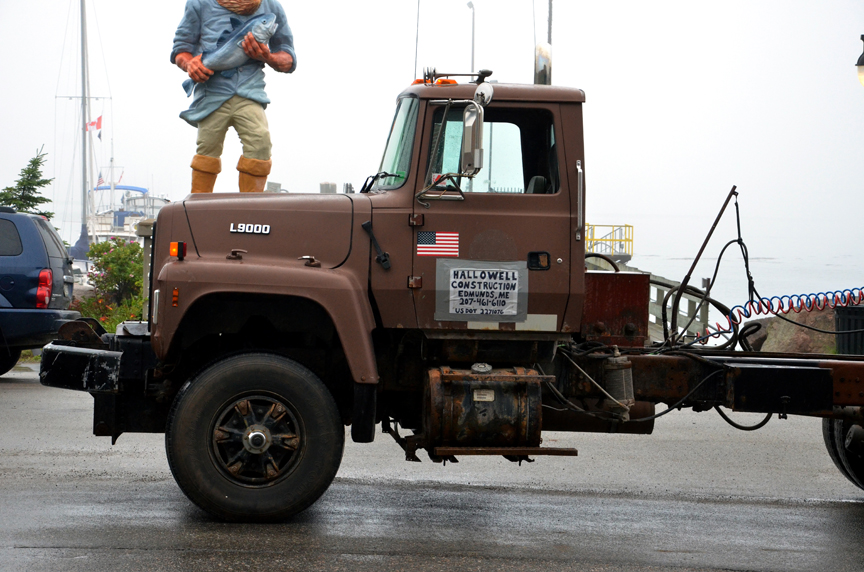
And here’s some wonderful wild signage which I saw from the front door of the studio while looking out to the wharf beyond. Notice how it is skillfully duct taped to the cab door.


The other reason for our trip was that Julian Smith, director of the Willowbank School for the Restoration Arts in Queenston, Ontario, was in town to give a lecture. I actually designed and printed the posters for this event back at Gaspereau Press earlier in the summer. The poster was handset in Monotype Baskerville and printed on a St. Armand paper.


When I got home again, I had to hit the ground running. As often happens during the summer months, this past week saw many surprise visits from other printers, writers and book lovers from all the place (including Toronto, Guelph and Jerusalem). When I wasn’t entertaining, I spent most of the week taking a final look at fall books before sending them to film and cranking jackets for the fall issue of the Fine Press Book Association’s journal, Parenthesis, through my big Vandercook. As the week wore on, it occurred to me that the wall which divided my office from the rest of the letterpress studio was no longer serving any practical function; it was a relic the early days of the press when we had more staff and needed more division of space. Why, I asked myself, was a I working in a small box at the end of a much longer room when I was the primary occupant of both rooms? So this weekend I tore the wall out and annexed the whole letterpress studio as my office. I am likely the only trade publisher in North America with ten printing presses in his office.

ANDREW STEEVES ¶ PRINTER & PUBLISHER